 Contact
 Support
 Wishlist
 Home
Home Categories
 PHP Script
 WP Themes
 WP Plugins
 66Biolinks Plugins
 Tutorial
 Important Links
 Hosting
 Services
 Request Item
 My account
Tech
Shared Hosting vs VPS for Running PHP Tool Websites: Which One Should You Choose?
Jun
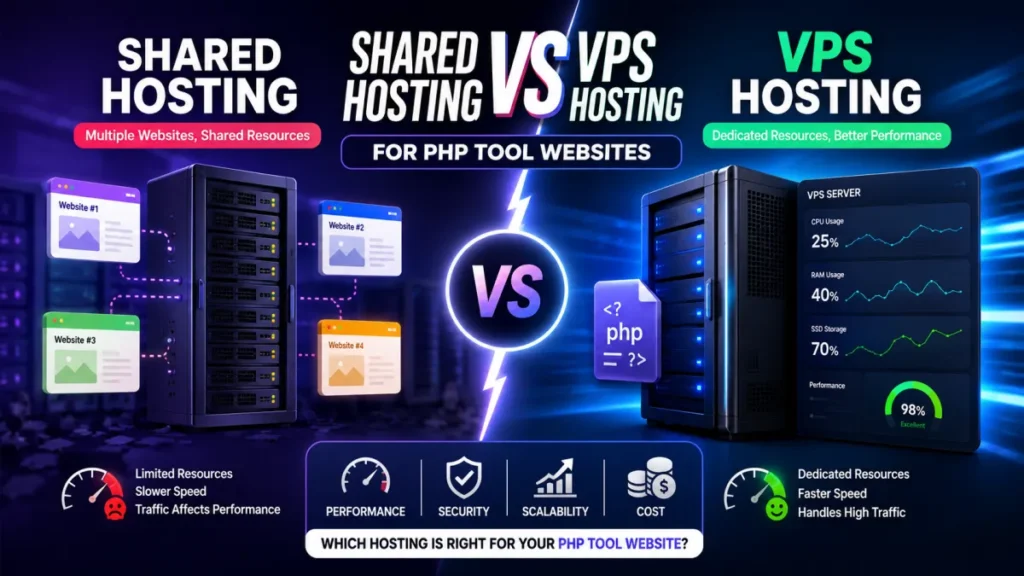
If you’re planning to launch a PHP-based tools website, one of the first decisions you’ll face is choosing the right hosting environment. Many website owners start with shared hosting because it’s affordable, but as traffic grows and resource demands increase, performance issues can appear. On the other hand, VPS hosting offers more control and dedicated resources but comes at a higher cost.
So which option is best for your PHP tools website?
This guide compares shared hosting and VPS hosting in real-world scenarios, helping you choose the right solution based on traffic, budget, performance requirements, and future growth plans.
What Is Shared Hosting?
Shared hosting is a hosting environment where multiple websites share the same server resources, including CPU, RAM, storage, and bandwidth.
Most beginners choose shared hosting because it is inexpensive and easy to manage. Hosting providers handle server maintenance, security updates, and technical configurations.
Benefits of Shared Hosting
- Low monthly cost
- Beginner-friendly setup
- No server management required
- One-click PHP application installation
- Suitable for new or low-traffic websites
Limitations of Shared Hosting
- Limited server resources
- Performance can be affected by other websites on the server
- Restricted server customization
- Slower response times during traffic spikes
- Limited scalability
For small PHP utility websites such as a simple calculator, text converter, or basic image tool, shared hosting can be a practical starting point.
What Is VPS Hosting?
A Virtual Private Server (VPS) provides dedicated resources within a virtualized environment. Unlike shared hosting, your website receives allocated CPU, RAM, and storage resources that are not affected by neighboring websites.
VPS hosting is often the next step for growing PHP tool websites that require better performance and flexibility.
Benefits of VPS Hosting
- Dedicated resources
- Faster loading speeds
- Better handling of traffic spikes
- Full server customization
- Improved security and isolation
- Easier scaling as your website grows
Limitations of VPS Hosting
- Higher monthly cost
- Requires basic server management knowledge
- More responsibility for optimization and security
Performance Comparison
Performance is often the biggest factor when choosing between shared hosting and VPS.
PHP tool websites typically perform dynamic processing. For example:
- Image compression tools
- PDF conversion utilities
- QR code generators
- SEO analysis tools
- Text processing applications
These tools require CPU and memory resources for every user request.
If you’re running tools similar to a QR code generator or offering image-related utilities from the image tools collection, resource consumption can increase rapidly as traffic grows.
On shared hosting, heavy processing can slow down your website. VPS hosting provides dedicated resources that help maintain consistent performance.
Winner: VPS
For websites expecting regular traffic or resource-intensive PHP processing, VPS offers a significant performance advantage.
Scalability and Growth
Many website owners underestimate future growth.
A website may start with a few hundred daily visitors but quickly expand after ranking in search engines or going viral on social media.
For example, if users frequently access a hashtag generator or use a popular link-in-bio creator, traffic can increase unexpectedly.
Shared hosting plans often struggle with sudden spikes. VPS environments allow you to increase RAM, CPU, and storage without migrating to a completely new platform.
Winner: VPS
VPS hosting provides better long-term scalability and growth potential.
Security Considerations
Security matters for every website, especially when users upload files or generate content.
With shared hosting:
- Multiple websites share the same server environment
- Security risks can increase if neighboring websites are compromised
With VPS hosting:
- Better isolation between accounts
- More control over firewalls and server configurations
- Enhanced protection for user-generated data
If your PHP website allows file uploads, image processing, or document conversion, VPS hosting provides a stronger security foundation.
Winner: VPS
Cost Comparison
Pricing remains the primary reason many website owners choose shared hosting.
Typical pricing:
| Hosting Type | Average Monthly Cost |
|---|---|
| Shared Hosting | $2–$10 |
| VPS Hosting | $10–$60+ |
For new projects, shared hosting offers excellent value.
For established websites generating revenue through ads, memberships, or premium tools, VPS hosting often delivers a better return on investment due to improved speed and reliability.
Winner: Shared Hosting (for beginners)
Best Hosting Providers for PHP Tool Websites
Several reputable hosting companies offer reliable hosting for PHP applications:
When selecting a provider, focus on performance, uptime, PHP version support, and scalability options.
Helpful Resources for Optimization
Before upgrading hosting, it is worth measuring your current website performance using Google PageSpeed Insights.
PHP developers can also review optimization recommendations in the official PHP Documentation.
When Should You Upgrade from Shared Hosting to VPS?
Consider upgrading when:
- Your website receives more than 10,000–20,000 monthly visitors
- Server resource limits are frequently reached
- Pages load slowly during peak traffic
- You run CPU-intensive PHP tools
- Users experience downtime or errors
- Revenue depends on website performance
These indicators usually signal that shared hosting has reached its limits.
Frequently Asked Questions
Is shared hosting good enough for a PHP tools website?
Yes. Shared hosting is suitable for new PHP tool websites with low traffic and limited processing requirements.
Does VPS hosting improve SEO?
Yes. Faster page speeds, better uptime, and improved user experience can positively impact SEO performance.
Which hosting is better for image and PDF tools?
VPS hosting is generally better because image compression and PDF processing consume more CPU and memory resources.
Can I migrate from shared hosting to VPS later?
Yes. Most hosting providers offer migration assistance or simple upgrade paths.
Is VPS hosting difficult to manage?
Not necessarily. Managed VPS plans allow providers to handle updates, security, and maintenance for you.
How much traffic can shared hosting handle?
It varies by provider, but many shared hosting plans can comfortably support a few thousand daily visitors before performance issues appear.
Conclusion
Both shared hosting and VPS hosting have their place in the PHP website ecosystem.
If you’re launching a new PHP tools website on a limited budget, shared hosting is often the most practical starting point. However, as traffic grows and your tools become more resource-intensive, VPS hosting provides the performance, scalability, and reliability needed for long-term success.
The best approach is to start with a hosting solution that matches your current needs while keeping future growth in mind. Regularly monitor performance, optimize your PHP applications, and upgrade when your website begins outgrowing its available resources.
